


Romania and the Potential of a Social Investment Fund: Bridging the Financing Gap for Impact
In a European context where the social economy is increasingly recognized as a key driver of inclusive and sustainable growth, Romania is taking important steps toward building a functional impact finance ecosystem.
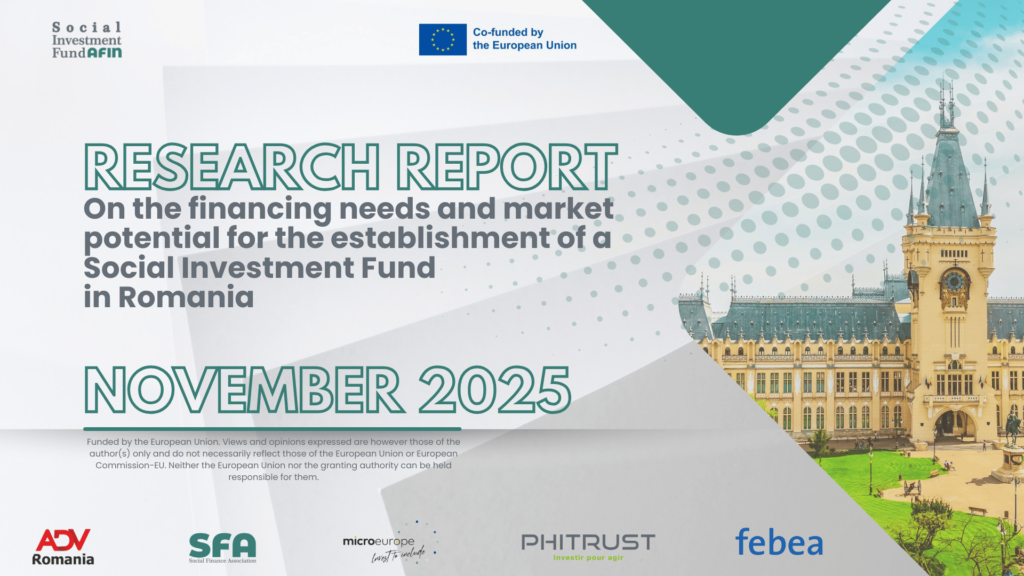
The 2025 market research conducted under the “AFIN – Social Investment Fund!” project provides a comprehensive analysis of both the financing needs of social impact organizations and the market potential for establishing a Social Investment Fund in Romania
The Social Economy in Romania: Growing, but Undercapitalized
Romania’s social economy brings together associations, foundations, cooperatives, social enterprises, and mutual aid institutions — all operating under a shared principle: prioritizing people over profit and reinvesting value into communities.
Key findings from the report highlight that:
-
Romania has over 120,000 social economy entities, with steady growth in recent years
-
Around 78% are associations, making them the dominant organizational model
-
Approximately 9,000 social enterprises are identified, though many remain informal or unregistered
-
The sector employs over 100,000 people
Despite this scale, its economic contribution remains limited:
-
only 0.52% of GDP
-
significantly lower productivity compared to the EU average
👉 This reveals a clear reality: the potential is strong, but insufficiently supported by adequate financing mechanisms.
The Core Challenge: Access to Finance
The report confirms a widely recognized issue across Europe and globally:
access to finance remains the most persistent barrier for social economy organizations.
Key insights include:
-
Around 75% of social enterprises seek external financing
-
Financing needs often reach up to 75% of annual turnover
-
Globally, the financing gap is estimated at over $1 trillion
In Romania, this challenge is further intensified by:
-
lack of tailored financial instruments (between grants and traditional bank loans)
-
perceived high risk among investors
-
difficulties in measuring and communicating social impact
-
limited financial readiness among organizations
👉 As a result, many high-impact initiatives remain small, fragile, or unable to scale.
A Structural Imbalance: Overdependence on Grants
Another key finding is the sector’s heavy reliance on non-reimbursable funding:
-
public funding and grants have the highest success rates
-
access to equity, impact investment, or venture capital is extremely limited
-
private capital engagement remains low
This creates an ecosystem where:
-
organizations depend on short-term project funding
-
long-term sustainability is uncertain
-
scaling impact becomes difficult
Why Romania Needs a Social Investment Fund
In this context, the report strongly supports the creation of a Social Investment Fund (SIF) as a strategic solution to bridge the financing gap.
Such a fund would:
-
provide flexible financial instruments (debt, quasi-equity, blended finance)
-
support organizations at different stages of development
-
attract private capital into impact-driven initiatives
-
strengthen a sustainable impact investment ecosystem
Experiences from countries like France, Italy, and Spain demonstrate that these instruments:
-
accelerate the growth of social enterprises
-
reduce investment risks
-
foster innovation and long-term sustainability
Investment Potential: Interest Exists, but Needs Activation
The research also explored investor perspectives (both national and international), revealing that:
-
there is genuine interest in impact investing in Romania
-
however, key elements are missing:
-
structured investment vehicles
-
strong intermediaries
-
investment-ready social enterprises
-
Investors are looking for:
-
clear impact measurement frameworks
-
risk-sharing mechanisms
-
scalable business models
👉 A well-designed Social Investment Fund could effectively address all these gaps.
Romania in the European Context: Progress, but Still Catching Up
Romania is currently positioned in a growing recognition phase of the social economy, but:
-
the ecosystem remains at a medium level of maturity
-
the concept of social enterprise is still narrowly understood
-
self-recognition among organizations is limited
In other words:
👉 the legal and institutional framework exists, but the ecosystem is not yet fully developed.
A Strategic Opportunity: From Potential to Systemic Impact
The report delivers a clear message:
Romania does not lack impactful initiatives — it lacks smart, patient capital.
A Social Investment Fund can become:
-
a catalyst connecting social entrepreneurs with financing
-
a mechanism for scaling impactful solutions
-
a bridge between social value and market sustainability
Conclusion
Romania’s social economy stands at a critical turning point.
With growing numbers of organizations, alignment with EU policies, and increasing investor interest, the foundation is already in place.
However, without appropriate financial instruments:
👉 this potential risks remaining untapped.
A Social Investment Fund is not just a financial tool —
it is a key infrastructure for building a more inclusive, resilient, and sustainable economy.